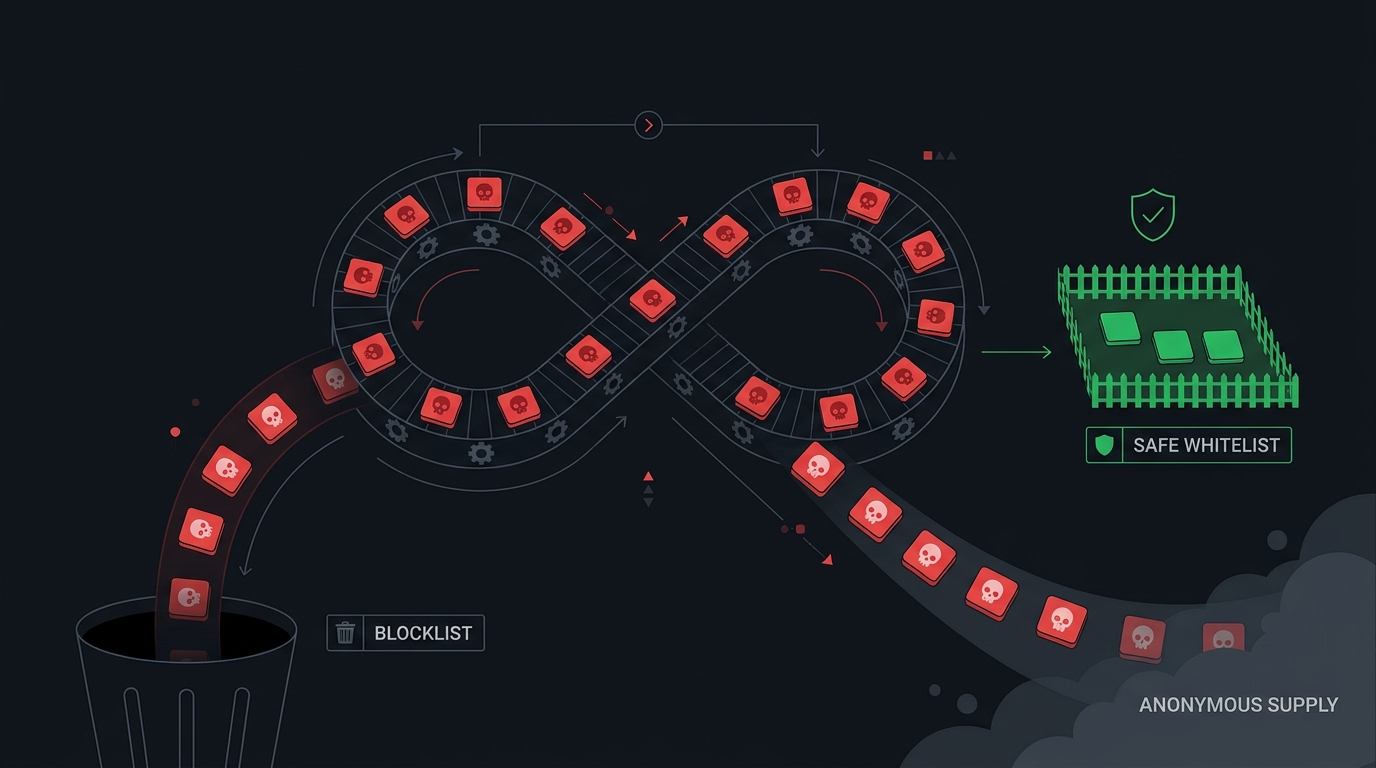
Here is a pattern every pop buyer knows and almost nobody names. You block 50 bad placements. Two days later your block list needs 80. A week later, 150. You start wondering whether your filter is broken — or whether the network is punishing you.
Neither. You are on the junk rotation treadmill, and it has a clean mechanical explanation — and one real exit.
What we measured
On one live pop campaign group, our system's exclusion list grew from 140 placements to 296 in roughly twenty-four hours. At first glance that looks like a disaster — twice as much junk! But the surrounding numbers tell the real story:
The block list doubled and traffic quality jumped and real visitor volume grew. All three at once. That combination is only possible if one thing is true: the junk is not static — it rotates.
Why the treadmill exists
Pop networks fill your campaign from an enormous pool of placements. When you exclude the worst ones, the network does not send you less traffic — it substitutes other placements from the pool. Some of the substitutes are clean. Some are the same operators under fresh placement IDs. Bot operations churn their identifiers precisely because buyers block them.
So a growing block list is not a sign your filtering is failing. It is the signature of filtering working against a rotating adversary. The number that actually matters is not the size of the list — it is the clean-traffic rate of what you pay for, and whether new junk gets caught in minutes or weeks.
The blacklist ceiling
Play the treadmill forward and you see its limit. Block-and-substitute converges only if the network's pool eventually runs out of junk. On networks where a third or more of the pool is bot placements, it never runs out. You will block forever, and every rotation cycle costs you the first few hours of each new bad placement's traffic — the detection window — billed at full price.
The exit: flip the list
The only structural exit is to stop enumerating what you refuse and start enumerating what you accept: whitelist campaigns. An include-mode campaign serves only from placements you explicitly chose. A freshly-minted junk placement cannot rotate into it — it is not on the list, so it never serves, never bills, never needs detecting.
The practical playbook we see working:
- Run discovery on exclude-mode with a modest budget. Its job is not profit — it is finding the placements that render, engage and convert. Accept that it rides the treadmill.
- Graduate proven placements to whitelist campaigns and put the real budget there. Rotation cannot touch them.
- Keep curating the whitelist — placements decay, sell traffic on, or get resold. A whitelist entry is a lease, not a marriage. (We wrote about the render-based whitelist strategy separately.)
FAQ
My block list keeps growing — is my filter broken?
Check two numbers first: your clean-traffic rate and your accepted volume. If both are rising while the list grows, the filter is winning against rotation. If quality is flat while the list grows, then investigate.
Isn't a whitelist campaign too small to scale?
It starts small. But whitelist traffic converts at what it converts — predictably — so you can raise bids on proven placements instead of spraying budget across a rotating pool. Most buyers find the whitelist campaign ends up their most scalable asset because its economics are stable.
How fast should new junk be caught on the exclude-mode side?
With zone-level intelligence, within minutes to a few hours of a placement going bad. If your detection window is measured in days, the rotation treadmill is billing you for every one of those days.