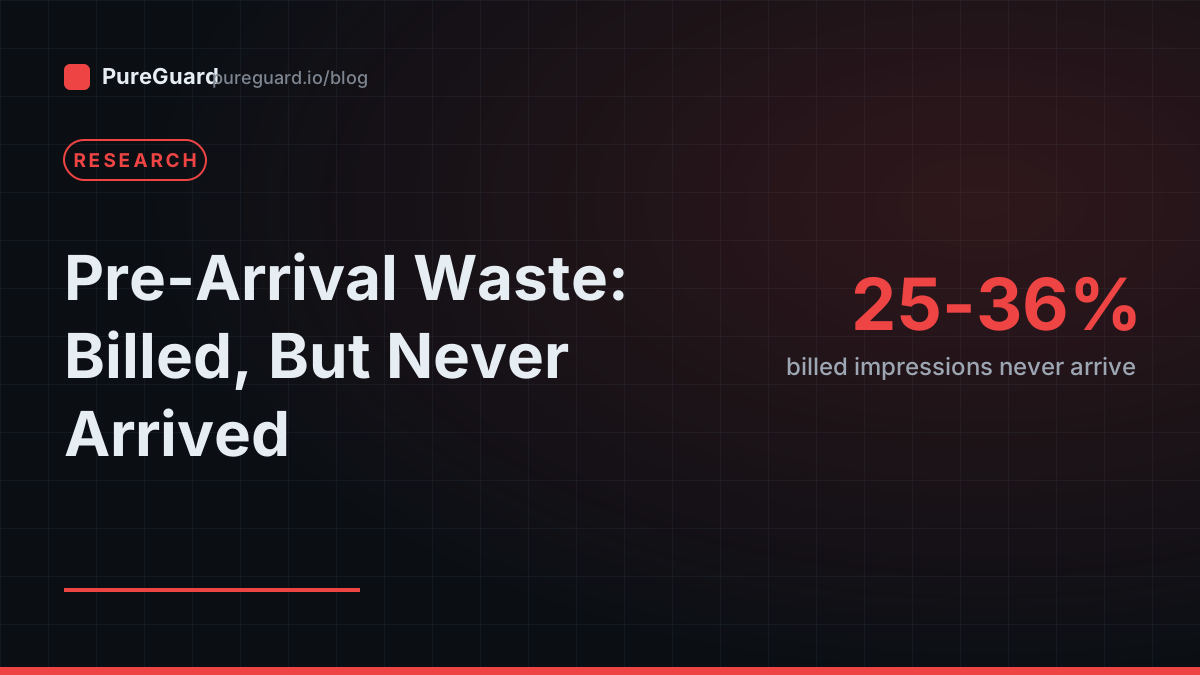
Before your landing page can render, before your bot filter can inspect anything, before your tracker can count a click — the traffic has to arrive. We reconciled a pop network's own billing ledger against our server's arrival log, second by second, for the same campaign over the same windows. The result: a quarter to a third of billed impressions never produced any request to our infrastructure at all.
What pre-arrival waste is
Pre-arrival waste is the gap between what the ad network's reporting says it delivered (and charged you for) and what your own web server ever saw. It is upstream of every other quality problem. Ghost traffic, bots, no-render visits — all of those at least reached you. Pre-arrival waste never did. There is no user-agent to inspect, no IP to score, no page to render. Just a line in a billing report and silence in your logs.
Because it is invisible to every tool that works from your server or your page, most buyers have literally never measured it. The discrepancy gets blamed on "tracker loss" or "analytics undercounting" and absorbed into the cost of doing business.
How to measure it honestly (the alignment trap)
The naive method — compare today's billed impressions against today's server hits — produces garbage, because network reporting and your logs disagree about time. Network counters update in bursts, sometimes lagging by an hour or more. Comparing a lagged ledger to a live log manufactures phantom waste (or hides real waste) at every window boundary.
The method that survives scrutiny:
- Snapshot the network's cumulative lifetime counters on a fixed cadence (we use five minutes) and never edit a snapshot. Windowed billing is then the difference between two immutable snapshots — if the network revises a counter downward, that is recorded as a revision, never as negative traffic.
- Count arrivals from your rawest edge — the first server component that sees the request. Not analytics, not the tracker's postback, not a JavaScript pixel: all of those sit downstream of losses you are trying to isolate.
- Compare only fully covered windows. In our measurement, one-hour windows were structurally unusable — the ledger's update latency exceeded the window. Six hours and up produced stable, reproducible rates.
Run this for a week and you will know, with receipts, what fraction of your spend buys silence.
What we found at zone level
The account-level rate (25–36%) is only half the story. Attribution by zone — possible because the ledger reports per-zone lifetime counters — showed the waste is heavily concentrated and strongly persistent:
- Zones qualifying with ≥8 billed impressions and ≤30% arrival held that behavior forward with 100% persistence in our validation split — every one kept under-delivering.
- The single worst zone billed 1,112 impressions over seven days and delivered 58 requests — a 5.2% arrival rate. That zone alone was ~8% of the campaign's total billed volume.
- 21 zones met the severe threshold; excluding just those recovered the majority of the measurable gap while sacrificing under 2% of real arrivals.
This is not a fraud accusation — a pop impression can legitimately die in the browser before the redirect completes, and the network's counter is technically honest. But the money is equally gone either way, and a zone that repeatedly bills 20 impressions for every 1 that arrives is a zone you stop paying, whatever the mechanism.
Why this category needed a name
The industry has vocabulary for invalid traffic, ghost clicks and viewability — all measured from your side of the wire. Pre-arrival waste is a different object: it can only be seen by reconciling the network's ledger against your edge log with disciplined time alignment. To our knowledge, this article is the first published measurement of it for pop traffic; PureGuard now computes it continuously (the "Pre-Arrival Yield" protection) for connected campaigns, excludes persistent offenders automatically under a commercial — not fraud — label, and releases them the moment their delivery recovers.
Related reading: ghost traffic (arrived at the click layer, never reached the landing page) and render rate (arrived, but never seen). Together the three form the full billed→seen economics of a pop impression.
Find out what you're billed for that never arrives
PureGuard reconciles your network's billing ledger against real arrivals per zone, and quarantines persistent under-deliverers automatically.
Start Free